Thursday, June 1, 2006

‘A Life in Our Times’

‘A Life in Our Times’
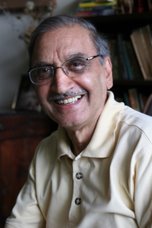
By Narendra Luther

I was a student of economics and topped the university in as an honours graduate. But by the time I did that, I developed a phobia for the creeping dominance of mathematics in economics. I therefore shifted gear and went on to political science to do my post –graduation. But later when I was selected as a British Council scholar to do a course in industrial management in Leeds, I was again confronted with the monster of mathematics in Operations Research. When I mentioned my difficulty to my tutor, he said math was simply a short hand. I could achieve the same result by long hand. That was consoling but like Alice in wonderland, I had to run faster to remain at par with my colleagues in the international group. In the flexible system of a western university, I was permitted to cross the hard terrain by giving two lectures on public administration!

Economics made easy

I mention this by way of background to how I came to study some one in economics who brought no mathematics into it. It was John Kenneth Galbraith who died recently at 97. I had kept up my reading of economics selectively even after getting a secure job and amongst the economists I came to admire were Keynes, Rostow and Galbraith. They helped me to appreciate ‘the economic system as a complex interaction of people and organizations whose actions cannot simply be understood through highly rational and mathematical models of the economy.’ Galbraith was able to communicate complex ideas in a compelling way to laymen

Here I intend to pay my tribute to Galbraith whose autobiography published in 1981 provides the title of this article.

Galbraith was born in Canada in 1908 but educated at Berkeley in the US and taught economies at Harvard. Politically he belonged to the Democrat Party of the United States. During the Second World War, he served in the in the Office of Price Administration and wrote a book on his experiences in controlling inflation. He also did a stint in the Fortune magazine. Out of that experience came the term ‘technostructure’ – the group of specialist managers who take the real decisions in organizations including governments. President. Kennedy, for whom he served as a speechwriter, appointed him ambassador to India where he served for two years from 1961. Here he developed a good rapport with Nehru who was then the prime minister. In his autobiography he deals with the situation and people in India.

Demolisher of myths

He challenged the traditional dictum that consumer is the king. The hapless consumer is manipulated and exploited by the firms through the medium of advertising. He also declared that the big firms were not at the mercy of competition; they gang up and control government. He had an elegant and provocative style marked by wit and sarcasm. He could not only take but also make a dig against himself and lampoon his subject: ‘Economics is extremely useful as a form of employment for economists’. Further, ‘the only function of economic forecasting is to make astrology look respectable.’

I never took him as an economist but as a jesting philosopher. He was the first to question the use of GDP as a measure of economic progress. The concepts of ‘quality of life’ and ‘Human Development Index’, which are now used by all agencies including the UN, owe their origin to his questioning the traditional methodology. He coined some of the other terms, which are today part of the current terminology of public discourse, like ‘the affluent society’, and ‘countervailing power’. He followed the tradition of Thorstein Veblen when he talked of ‘private affluence and public squalour’. I believe it was out of that challenge that the current concern for ecology grew.

Men and chairs

My favourite passage comes from his book The New Industrial State. How perceptively he divides human beings in to two categories:

‘Clearly some individuals do add luster to organization. The accomplishments of the great physician are his own, not those of the hospital where he serves. The achieve­ments of the poet are his own, not those of the institution where he is currently the artist in residence. Similarly the opera singer or actor and, though not always, the great scientist.

Men are, in fact, either sustained by organization or sustain organization. They are either esteemed because­ of organization or the organization is esteemed because of them. The individual is himself rarely a sound judge of these matters. Those who are esteemed because of organization almost invariably attribute the acclaim to their own personality. ­

But there is an infallible test. That is to observe what happens to the individual when he leaves the organization or retires. The great physician is not greatly diminished by being separated from his hospital. Nor, except as regards regular salary, is the poet when he leaves the university. Nor is the competent newspaperman when he moves on. Nor the great scientist nor the entertainer. They sustained, were not sustained by, the organization to which they belonged.

By contrast the politician when he is defeated, the ambassador when he retires, the university president when he becomes emeritus and the peacetime general who fails to become a corporation president face total obscurity. They were sustained by organization; on losing its support they pass permanently into the shadows. To some who have naturally assumed that their eminence was their own the shock is very severe. Others sense their situation. Nothing explains the primordial vigor with which politicians fight for office and seek retain it to senility and beyond. Between being in and out of political office the difference is not slight. lt is total. "


I endeavoured to belong to the fist category.

Besides his best selling books on Economics, Galbraith wrote two novels, a book of satirical sketches, and a study of Indian painting. In 1977 he presented the BBC television series based on his book The Age of Uncertainty which deals with the evolution of economic thought since Adam Smith,

The laughing philosopher

His Memoirs is gripping because of his candour, humour and anecdotes. Ambassadors, he observed, have barely work for an hour a week if they represent important countries. Their cocktail parties, ostensibly a means for gathering intelligence and information, rarely serve that objective.

The Memoirs contains eight maxims for success in working in government. He admits candidly that he revised all his draft five times – the Memoirs underwent six revisions! ‘My spelling is often impressionistic; my punctuation is erratic; so more rarely is my syntax; my memory though generally good, is subject to lapse… my sense of taste is fallible; and so too is my impression of what is or is not clear’. His editor, Andrea Williams rescued him. He spent three to four hours daily on his current book in addition to the time reading and thinking on the subject.

Galbraith gave many like me me instruction and illumination when he seemed to be only entertaining. I salute him.

* * *

Archived by www.mygoldencopy.com

Monday, May 1, 2006

Advice on advice

Advice on advice
By Narendra Luther

Advice is what you ask when you already know the answer but wished
you didn't.

Nothing is so readily given and so grudgingly taken as advice. The tendency to indulge in it is directly related to the age of the dispenser. In fact, a senile person tends to repeat the same advice to the same person. It has nothing to do with the success or failure of the free vendor of advice. On the other hand an unsuccessful person gives advice by of warning by giving his on example. Every parent has a lawful right to give advice to his children irrespective of their capacity to do so. Some children succeed in life by disregarding the parental advice. Giving advice is one way of showing superiority on one’s part. It is assumed that if you give advice you are deemed to have been a success in your life. Asking for it also often cloaks a subtle form of sycophancy. When a person asks what is the secret of your health or success, he makes you feel you are a healthy/successful man. After that the adviser is disposed to grant favour to the seeker of advice, which generally is the original objective of the seeker of advice.

Three ways

There are three ways of giving advice. First is the direct personal method. That method relates advice to one’s own experience. It gives examples from one’s own achievements or failures. Hard work, thinking big, pursuing a dream, facing risks, braving odds, standing up for truth and honesty, systematic approach to work, slow and steady pursuit of a goal, good PR with people are some of the elements of various pieces of advice to which children at home are subjected by way of rehearsal. Since they can’t but listen to it the advice-giver is emboldened to step out to a wider circle. If he does not encounter any rebuff there, he then moves further into the wide world and preys on people enjoying themselves in groups or parties. In religious gatherings and political meetings, willing victims are found in plenty. Annual functions of educational institutions and celebrations of similar kind are good occasions for worthies to impart advice to youngsters and other members of the audience on character building and achieving success in life. It may even go to the other side and exhort the listeners not to care for mundane success because there are better things in life than to hanker after for material success. It depends upon what sounds better.

The Approach

The approach can be self-centred or objective. In the former case, one relates every piece of advice to one’s own success or failure. It starts with a declaration: ‘When I was your age…’ or When you reach my age…’ or ‘what I am’, I am because…’ or ‘I believe.’ or I always practised…’ Youngsters don’t like this approach because it has a parental ring about it. Elders too don’t feel happy about it because of the ‘I’ element in it. But the recipients are victims of good manners. We all are. In this case it is better to dwell upon one’s failures. That makes for novelty which is more interesting. Also it is nearer the truth because, come to think of it, every one is a failure in a manner of speaking. That is because ambition has no limit. It grows on itself. The more you achieve, the more you want to achieve. Even if you become the president of the country, you may feel you should have achieved it earlier or secured more terms than you did. There is always a way of looking at things. Talking about one’s failures openly puts one’s audience at ease. They feel they are not so inferior after all.

The Impersonal Approach

The other approach is impersonal. You don’t bring yourself into the discussion. You talk about the philosophy of success and failure and give examples from scriptures or epics, biographies and autobiographies. Mythological and historical figures provide good raw material for this exercise. How did Arjuna become an outstanding archer? Why was Yudhishter’s dog admitted to heaven? Why did Alexander stop where he did? Why did Aurangzeb win the War of Succession? How Tagore came to establish the Shantiniketan? There is no end to anecdotes and stories that tell the secret of success and failures. Such impersonal references make one appear both non-egotistical and learned. They serve to enhance the speaker’s reputation as a widely read man.

Practice or Precept

The third method is not to give advice but to make it available by practice rather than precept. You do not advise, you do not preach but do your own job. If you make a mark, you will automatically become a role model for some people. Unbeknownst to you many youngsters – and surprisingly many oldsters too -- will try to emulate your example. After all how many of us have met men like Mahatma Gandhi or Nehru or Nelson Mandela - to mention only three from a galaxy of names of people who have made a difference in the world - in flesh and blood. But two generations of Indians and innumerable persons from abroad have tried to draw lessons from their lives. People have read their autobiographies or biographies or read about or heard about them and striven to adopt their ideals. That is the best form of advice. Such persons remain mythical figures rather than concrete persons and inspire the masses as invisible gods do – or even God does. Real-life idols sometime reveal their feet of clay and the ensuing disenchantment occasionally disorients the worshippers and followers. That is why leaders keep a distance from their fans and followers. That is how they retain their mystique. Ideas are more powerful than persons and ideas outlive persons who conceived and propagated them. If the ideology fails, it is the surviving practitioners who are blamed. It is therefore good for heroes to die early. Imagine J.F. Kennedy living to ripe old age and being found out as an expert philanderer. Those who have to give something don’t delay. They make their gifts and depart. Of course there are some exceptions and you all know about them. One good feature about any advice is that it should be brief and this discourse seems already to have violated that canon. So it is time I hung up.

I for one don’t believe in giving or taking advice. I can pick up a piece of advice depending upon the occasion from numerous sources. As for giving it, I give it only to my dog. He does not care. He does not listen. Yet he wags his tail as if in gratefulness. He lives his happy life as he is destined to. As he is content to do. To his wagging tail is attached a piece of advice – for me as well as you.
***
Archive by www.mygoldencopy.com

Saturday, April 1, 2006

No Free Lunch, but…

No Free Lunch, but…
By Narendra Luther

Thee is a modern American saying that ‘there is nothing like a free lunch.’ But what about water? So far restaurants have not started charging for water unless it is the mineral variety. In fact in India even before taking your order, the bearer plonks a glass of water in front of you, particularly in the South. No body asks you to pay for it in case you change your mind and having slated your thirst, decide not to eat there and walk out.

It used to be a common practice to set up stalls on roadside offering water to general public on festivals and auspicious days, like the birthdays of some Sikh Gurus, and the Muharram procession. That is supposed to earn you spiritual ‘merit’. Thanks to the shortage of water, this tradition is fading now.

For our domestic water supply we pay as a matter of course. The charges keep on increasing every now and then and we submit to it with a murmur. It is called ‘safe’ water supply though most of us either boil water before drinking it or use water purification equipments like ‘Acquaguard’. My wife uses both of them to make sure we don’t suffer from any water-borne disease.

Free Water

But in the countryside water is still free though its safety is not talked about. One can draw water from a river, a lake a well or a pond. Or at least that is what we thought. A screening of a recent film by K.P. Sasi ‘ ‘The Source of Life for Sale’ was an eye-opener. Water is an indisputable source of life. Seven–tenth of earth and two–third (women0 to three-fourth (men) of human body are composed of water. Animals and humans die more of thirst than of hunger. Dehydration is a great cause of death particularly amongst infants who can’t spell out their demand for water. Lack of water causes drought and that results in famine. That in turn leads to suicide by farmers and death for the poor. Thus, water is more important to our life than we imagine.

Sasi’s documentary takes us from Kerala to the North via Chhatisgarh and showcases how water which has been traditionally available free to people is being denied to them.

Rivers in Periyar, Malampuzha. Attapadi, Sheonath and Kelo, and parts of the Ganga Canal have been sold to private firms to make coca cola to be sold in the market. Small, scattered communities including tribals who depended on the water for their crops and for their domestic needs were shown forcefully protesting against it. NGO’s marched in procession raising slogans venting their anger. An old unlettered tribal woman showed a rare degree of eloquence in her denunciation of the deal made by the government. An old man voiced his betrayal by the MLA of the area for his ‘collusion’ with the private party. The firm had thrown a bund across the river to pump out water for its plant. That meant the lower part of the river became dry and the lower riparian habitations went without water. There were accusations of corruption against authorities in deals involving such sales.

The problem of water shortage is compounded by the over- exploitation of ground water as revealed by a recent survey. It has been said that the future wars will be not for oil, but for water. It seems that we already witnessing trailers in the interstate disputes about water in our country.


The Garland Canal Project

The film showed with telling effects what it means to be deprived of water. The sale was described as a part of privatization and globalization. Multinationals come and grab resources that belong to the community, for their private profit. Once we swore by Socialism. Today the pendulum has swung to the other side, to Privatization.

The film also made out a case against the project of the interlinking of rivers – the ‘Garland canal’ system. The eminent engineer, the late Dr. K.L. Rao conceived it long before there was any debate about socialism versus privatization. He believed it would rid the country of the spectacle of simultaneous drought in some areas and flooding in others. The NDA Government approved the massive project in principle and it is understood that preliminary technical studies have been initiated on that. It seems perfectly logical inasmuch as it will ‘even out’ the levels of water in all the rivers in the country. But, the opponents of the proposal argue that it ignores the ecological aspects of the various river systems. Interlinking will entail bunding of rivers and diversion of water at a number of places. That, in turn, will result in diminution, if not denial of water to downstream areas. Damming of rivers will also cause submersion of vast areas displacing communities in different parts of the country. It is against that that prospect that persons like Medha Patekar are agitating.


Wisdom of Tentativeness

I would concede that some of the proposals for new uses of have been made by experts in the genuine belief that they will promote the welfare of the people as they perceive it. That brings us to the crucial point of how much reliance we should place on expert advice. The best of experts sees only his side of the picture. In fact the more the specialization, the more the narrowing of the focus. There is a loss of width of vision in specialization. A specialist does not - indeed cannot – appreciate the opposing point of view. For policy - makers and final decision- takers, it is necessary to integrate the Hegelian thesis and anti-thesis into a synthesis. There is a greater need for debate on such issues than we have today in spite of our legislatures where the party line over rides the need for the examination of the merits of a proposal. The view of the party in power often is nothing but the command of the leader right or wrong. The policy of the Opposition, on the other hand, is based on its obligation to oppose. In how many cases have opposing line being taken on a given issue by the same party depending on whether it is in power or in opposition?

Sitting through the screening of Sasi’s documentary, I felt sorry at the poor attendance in the hall. More so because I saw no bureaucrats and politicians for whom the film would have appeared heretical against the current official dogma. I felt that such films should be screened in the secretariats and before experts and the intelligentsia so that different perspectives can be seen by those who are going to decide the fate of millions of the poor of the country. As Bertrand Russell put it, ‘Fools are cocksure; wise men are in doubt’. In other words, the need is for an open mind. That will enable us to take a holistic view before taking a final decision.
***

A time for exit

A time for exit
By Narendra Luther


I don’t mean to exit from this world but a prelude to it. I mean the time to superannuate, to stop working regularly for a job, or as is commonly put, to retire.

Full man, half pay

Before retirement the wife gets half husband and his full salary. After retirement, she gets back the full husband and half his salary. The age of retirement is decided on the basis of a multiplicity of factors like expectancy of life and the state of health, and the availability of manpower in any society. It varies from country to country and time to time. The key consideration is the level of mental capacity in most jobs. In India it used to be 55 for the employees of government under the British and remained pegged at that for a number of years after independence. Then it was argued that our expectancy of life which was thirty-three at independence had risen to over sixty. Also 55 was too early for retirement. While the employee had still many family responsibilities to discharge, his income was suddenly reduced to half. On the other hand, the government lost the benefit of mature experience and advice. Basically, it was the serving employees who wanted to prolong their tenure. So the government extended the age of retirement to 58. After some years when the government’s financial position was tight, the employees gave an ingenious helpful suggestion. If the age of retirement were extended by another two years, the government would make huge savings by postponing the disbursement of terminal benefits to retiring employees. It would also maintain the same establishment costs instead of adding pension to the salaries of new employees. Also, India would automatically become closer to the western advanced countries where the age of retirement was well over 60. Of course the old arguments of a further increase in the expectancy of life, better health and maturity of experience of older employees were always there. So, the government again succumbed and extended the age of superannuation to 60.

In the U.S. the age of retirement is 65; in England 68. It is around that figure in most of the advanced countries of the West. With them one of the reasons is shortage of manpower. They make up this shortfall through selective immigration. They issue work permits and allow immigration in crucial sectors in which they need people. They can thus pick up the best readymade human capital from all over the world. In a way the under- developed and developing countries extend massive assistance to developed countries through the supply of trained manpower. Considering the overall cost of turning out a physician, an engineer, an architect or the like, it can be safely assumed that for every person going to the developed counties of the West, from India, we are giving them an invisible financial aid of at least 10 million rupees. But that is a digression from our theme. Let me return to it.

The main consideration for sending people home on retirement is their lowered physical and mental capacity. That is why in the civil list retired employees are listed unfeelingly under ‘wastage’. Experience of thirty years, which some old fogies boast about, is nothing but the experience of ten years multiplied three times. According to experts, there is a gradual loss in physical and mental faculties which sets in after 40. It becomes pronounced around sixties when one moves towards old age and senescence.

Never say die


While for normal job the age of superannuation is determined on the basis of old age, it is ironical that for more important jobs, the age of superannuation is either higher or nonexistent. For example, all our constitutional posts have a higher age limit. The judges of High Courts retire at the age of 62; of the Supreme Court at 65. Members of the State Public Service Commission retire at 62, of the Union at 65. So is the case of the Election Commission and the Central as well as the State Administrative Tribunals. Recently the Chief Commissioner under the Right to Information Act and the State Commissioners have been appointed. All of them are retired bureaucrats. Retired judges of high or Supreme Court are appointed to head various commissions of inquiries which are set up every now and then.

There is no age limit for governors, legislators, and ministers. All governors are either retired servicemen or politicians. Legislators and ministers take the most crucial decisions affecting various aspects of our life, well-being and liberty. So is it to be assumed that the normal rule of nature as to the diminutions of faculties does not operate in the case of these important high functionaries.

In the case of judges we are told that a higher age for retirement ensures their independence. Can two or five years more than other functionaries do that? The lure of commissions after that term should be enough to dilute that. The constitution of the U.S. has sought to ensure independence of the judges of the Supreme Court by giving them a term for life. That provision can certainly ensure independence. Apart from them in most countries Field Marshals of the armed force also don’t retire. But that is by way of honour. Both Judges of the Supreme Court and Field Marshals stop attending office whenever they feel like but continue to get their full salaries and perks.

In the case of our legislature that is our MLA’s and M.P s, and the political executive, the argument is that they are elected by the people and it is for them to decide whether a particular person is too old to discharge his functions properly. So, we will continue to have presidents, prime ministers, chief ministers and ministers who may suffer from multiple disabilities but who directly or indirectly manage to secure the necessary endorsement.

Fact and Myths

So we have one fact and three fictions operating in our system. The fact is that beyond a certain age the physical and mental faculties of individuals decline preventing them from giving their best. The first fiction is that this law of diminishing faculties does not operate in the case of higher jobs. The jobs inject appropriate aphrodisiacs into the system of ageing persons. The second fiction is that the pull of power and pelf declines two to five years after the normal age of superannuation. The third fiction is that the masses know whether a person can continue to perform long after the normal old age.

The moral from our prevalent practice is that you require fit persons with limited wear and tear for lower level of jobs. For higher jobs impaired faculties are prime qualifications.

It may appear to be a bundle of ironies and contradictions. But that is life - a fiction based on further fictions. So, stop grousing and accept the facts and fictions of life - so says saint Kabir.

***
Archived by www.mygoldencopy.com

Wednesday, March 1, 2006

Bush shirt and Buffet

Bush shirt and Buffet
By Narendra Luther

Americans gave the world the bush shirt and the buffet after World War II. These improvisations were to meet new exigencies. Now they are part of accepted norms in dress and entertainment. Their search for the novel and the innovative is continuous and unending.
In the last few weeks during my tour of the United States, I have had ample opportunities to study various aspects of life in America. I am impressed by the fact that they have managed their affairs so well. Their genius for improvisation is something to be admired. For every conceivable physical, social and psychological situation they have devised coping mechanisms. Their range of inventions and innovations for dealing with domestic chores is vast. Supermarkets offer a fascinating range of home tools for every conceivable situation. Their town planning is meticulous and there is no question of any one getting away with the smallest violation. Their concern for the aged – whom they call ‘seniors’ – is touching. I visited some residential complexes for seniors. If there is a heaven, it must be quite close to the conditions prevalent there. The care with which they deal with the disabled is also remarkable. They are provided for separately in every public place and utility. Even the meanest establishment has public conveniences – what they call ‘Rest Rooms’. Their traffic regulations are stringent and any violation is strictly dealt with.
Innovative approach
Their craze for experimentation is reflected in the number of titles of books published every year on every conceivable topic. Some of the books I read included ‘Dying Well’, ‘Why We Die’, ‘Meetings at the Edge’, ‘The Professor and the Madman’, and ‘The Art of Imperfection’. They gave insights on life, disease and death. The quaint titles of books in stores and libraries suggest the range of research going on in various fields. Hard to believe but according to Andrew Gabrois of R.R. Bowker Co., 185,000 titles were published in the US in 2004. No subject is taboo for them. People experiment and share their experiences freely. The new knowledge and analyses generated are available in bookstores and public libraries where, incidentally, the use of Internet is free. An average city library is better equipped than most of our university and official libraries. The quality of service and the courtesy of the staff are incredibly superior to any thing one gets in India. The World Economic Forum in its report for 2003-04 lists technological advance as one of the three determinants of the Growth Competitiveness Index (GCI). U.S. is one of what it calls the ‘core innovators’. It is not so in technology only, but in its parent -- Attitude. You see that attitude documented in the museums spread all across the country.
Dignity of Labour
No body feels embarrassed by the way they dress. I never had an occasion to wear any dress except the most casual. The consideration that guides the choice of dress is functionality and convenience.
The other thing that strikes one is the dignity of labour. No body is ashamed of doing any thing to earn a living. Students working as waiters are quite common. I met two female university professors. One was living with a carpenter and the other with a truck driver.
Our Advantage
I talked to many persons of Indian origin about some of these features of life in America. They all agreed that it was indeed a distinguishing mark of the American society. Their explanations varied. One refrain was that it is because of the small population that all that is possible. It is both a cause and an effect of prosperity.
In India all our progress is negated by the growth in numbers. The fall in law and order is also largely due to that. It is true no doubt, but is rather a simplistic explanation. Also a deeper analysis of the demographic profile encourages some hope for us in India despite the growing numbers. Today, thanks to advances made in public health and social security, the population in the advanced countries is ageing fast. In Europe in 1950, the population over 60 years of age accounted for 12%. In 2050, it will be 32%. On the other hand, the population under 14 will decrease from 27% to 16%. Today 66% of the expenditure in European countries is on education, health and pensions. With the ageing of the population, this will only increase and they will be caught in the Wagnerian bind. This will result in an increase in the public debt. A similar phenomenon is taking place in the United States. According to the March 2005 issue of the Harper Magazine, for every two workers in General Motors there are five pensioners. As against that, in India by 2030 the ratio of working population will double while the increase in the dependent population will be marginal. That will give an edge to India against the developed west.
Our Productivity
But before we proceed to celebrate the prospect, let us pause to consider the balancing factors. First, our per capita productivity is about one tenth that of the U.S. One example will suffice. According to the Institute of Management Development, Lausanne, during the past decade, steel production in the US has jumped from 75 to 102 million tons while the number of workers has fallen from 289,000 to 74,000.

Immigrants’ paradise
A further sobering remark was made by a young Indian analyst in America. The emerging adverse demographic profile of the States will be countered by the immigration policy of the U.S. It can tap the productive segment of the population of any country to meet its needs. It can select, it can pick and choose and so meet its critical requirements in the economy. America is an immigrants’ paradise. For those who have visited the Ellis Island and seen the historical statistics displayed in the Museum so attractively, understand the America was built by the best of immigrants from all over the world. The process has not stopped yet. Because of the factors mentioned in the beginning of this essay, the US still remains the magnet for every ambitious person in the world. Young people all over the world are ready to serve America by providing it the most critical resource – human capital. America does not have to spend on skilled manpower; it has just to open the gate and hordes of young, highly skilled, hard working, ambitious persons from all over the globe will rush to meet its needs and more. America is great because the rest of the world is continuously engaged in contributing to its growth. We may criticize it, abuse it, revile it, but we are always at its beck and call and our best talents are only awaiting an opportunity to be let in to the land of opportunity.
High growth is both its cause and effect. There is some food for thought in that.

***

Archived by www.mygoldencopy.com

Wednesday, February 1, 2006

A Pilgrimage to Childhood

A Pilgrimage to Childhood
By Narendra Luther

Last month we made an unusual pilgrimage -- in search of our roots. Both my wife and I belong to the part of India that is now called Pakistan. I was raised in Lahore while she came from a landed family from further west, Bhalwal and Malakwal. Smaller places, but a richer family – at least that’s why I had been told by a woman who wasn’t rich by any standards when I married her. She had often talked about the vast lands and the cotton ginning factories, which her families owned before the partition of the country.

The flight from Delhi to Lahore takes only 45 minutes and since the Pakistan Standard Time is set half-an-hour behind India’s, we were there in fifteen minutes.

Loitering in Lahore

I had distinct memories of every place of my childhood in Lahore. I looked for my grandfather’s house on Infantry Road in the cantonment area. It should have been easy. There used to be just two largish houses facing empty fields. Now there was a congested area with houses all around and no trace of fields. We asked a number of old people but no body could help. When we were about to give up, a young man asked me if it was a light yellow painted house. I said yes. He said his uncle had bought a house and was demolishing it to build a complex there. Then he took us across the road and I saw a quarter of the house still in tact. He said if I had come a week earlier, I could have seen the whole house. Then I went to the canal where I learnt swimming. After that I saw my old school, the college where I would have gone in due course, the road which we took to the Mall, the Lawrence Garden, now renamed ‘Jinnah Garden, and Anarkali, the which used to be the best bazaar.

We saw the famed Lahore Fort built by the Mughal emperor Jahangir and the Badshahi Mosque built by his son Aurangzeb. At the foot of the mosque lies the mausoleum of the poet Iqbal who is considered the spiritual father of Pakistan. He also composed what is now India’s informal national anthem – ‘Sare Jahan se acchha...’’. The Fort later became the seat of power of the Sikh ruler Ranjit Singh. His mausoleum lies just outside the fort and by its side is a Sikh Gurudwara dedicated to the fifth Guru of the Sikhs who was executed by the Mughal emperor, Jahangir. He composed the Adi Granth, the holy book of the Sikhs which incidentally has a number of compositions of Muslim saints. It was heartening to see a Sikh temple in the shadow of a mosque.

Jahangir & Noor Jahan

The Mughal emperor Jahangir is also buried across the river in a grand mausoleum. Not far from him is his queen, Noor Jahan’s mausoleum. It presents a stark contrast to her husband’s grand mausoleum who, according to his memoirs, had bartered away his empire to his beloved queen in exchange for a daily heavy drink from her hand.

The Government has preserved the garden city character of Lahore. The people give credit for that to the former Prime Minster, Nawaz Sharif and his younger brother, Shahbaz Sharif who was the Chief Minister of the Punjab. Some beautiful new colonies have come up with spacious single-storey mansions. We did not see many high-rise buildings. Lahore used to be called the Paris of the East. I am inclined to call it Venice with the canal running through most of the city. They also have not changed the old Hindu names of buildings and colonies. ‘Dharam Pura’ where my father had a house was unrecognizable but retains its name. I can’t resist the temptation of dwelling longer upon the city, but I must leave some space to my wife.

After a week of nostalgic trips which included two receptions by the writers of Lahore, we left for my wife’s ancestral places about 150 kms away

Wife’s Home

The journey began with a surprise. The car soon got out of the city and started on a motorway. It is a magnificent eight-lane highway just like the motorways in the United States. The car ran at 120 kmph without our feeling the speed. All the drivers including ours observed the rules of highway driving, as I had seen in US.

We went off the motorway to reach the town where my wife’s family owned cotton-ginning factories next to the house of Sir Feroze Khan Noon who became the Prime Minister of Pakistan later. The old sleepy town had changed dramatically. The over 100 year-old red brick mansion where my wife was born stood there somewhat neglected. A board proclaimed it was now ‘Paragon Model School’. The comely headmistress took us around and the whole place was abuzz with excitement that the original owner of the house, an Indian had come to visit. While we were going round the building we got a message that some people wanted us to visit them. That was a family of the daughter of the maid who worked for my wife’s family. Her father-in-law was the labor contractor for the factories. The family had done well and she insisted that we stay there for the night. Not being able to do so we had tea with them. When we were leaving she put a bagful of ‘fruiters’ -- a new hybrid citrus fruit in our car. Her son told us that the area no longer grew cotton but an abundance of ‘fruiters’ and so was called the California of Pakistan.

As we approached the next town where my wife had spent her adolescent years, she eagerly looked for chimneys of the factories which they had owned. None was to be seen. From outside the town a steel shop owner offered to accompany us. On the basis of cues provided by my wife he took us to the house. It was not only in tact but was being lived in by a large joint family. The head of the family, an old man of 85 rattled off the names of my wife’s grandfather, father and uncles. My wife wiped her tears as she bowed down to touch his feet. I felt a lump in my throat as I witnessed the scene. What happened to so and so and so and so? All of them were dead!

The family took us round to each room -- and then to steel safe embedded in the floor of the bed room. It could not be removed because it weighed five quintals. Of course there was nothing in it to which my wife could lay a claim.

I could write a whole book on this journey – and our respective childhoods. We got so much affection from the people there that both they and us wondered why the country was partitioned?
***
Archived by www.mygoldencopy.com

Sunday, January 1, 2006

A Window on Pakistan

A Window on Pakistan
By Narendra Luther

Last month I wrote about our trip to Pakistan in personal and emotional terms.
Only those who have undergone a trauma of the type which entails forced relocation and loss of entire property can appreciate that sort of reminiscence. The only saving grace for persons of my generation was that we were children and we had lost something which we had not created. I can now imagine the acute distress that our parents must have undergone.

This time I intend to dwell upon the comparisons and contrasts between the two countries.

Military Regime

The first point that struck me was that the people there were invariably not in favour of the military regime. Many had experienced similar spells of military dictatorship earlier and they did not relish any of them. They envied us our democratic system. Some asked me how we could stay free of military rule and whether there was any danger of the military ever taking over in India. I said that we were lucky in our earlier leadership both in their deep commitment to democracy and their longevity. Jinnah died within a year of the birth of Pakistan. The second in command and stature, Liaqat Ali Khan was assassinated shortly thereafter in 1951. There was thus no outstanding leader left after that. It is a moot point whether military rule could have been avoided if their founding leaders had lived longer. Most people expressed their preference for political leaders like Benazir Bhutto or Nawaz Shareef even if they were corrupt. There is something in the knowledge that you can throw the rulers out in a peaceful manner through the ballot box. Only a politician can have his finger on the pulse of the people!

Low Industrialization

Many persons from across the wide spectrum observed that India was a century or two ahead of Pakistan in terms of general progress which included industrialization and the emergence of the service sector. It was after going to Pakistan that I realized the importance of the presence of the public sector in some areas, like public transport. It was privatized some years ago, probably by Nawaz Shareef. A ‘common man’ told us that some ministers and their families and friends now run minibuses and taxis. This, we saw, caused serious inconvenience to the common man.

We were surprised to note the absence of official or cooperative dairies producing milk and milk products. You get milk either from the old conventional milkman or from the grocery shop in imported powder bags. Price of both milk and sugar are rather high.

We noticed the absence of indigenous industries in Pakistan. You get every kind of consumer good there because they are imported. There are many large malls and supermarkets and all sots of goods are available there. They produce good fruits and vegetables but there is a lack of food processing industries.

Though the penetration of cell phones is high, I did not find any cyber - cafe in Lahore. While I was there, the Prime Minister declared that a Technology Park would be set up soon and would be ready in a year.

I found the media rather insipid. Newspapers lack ads. Their contents are mild though here and there you find some strident ant-establishment columns. TV shows a number of India channels and our actors and singes are very popular there. Aishwarya Rai, Sushmita Sen and some other Indian beauties are modelled in Pakistani textile shops. Local video and audiocassettes are of poor quality.

No Burqas

We did not see any purdah or burqas in the new part of Lahore, or in Islamabad. Even in the old parts of the cities, it wasn’t there to the extent that we expected. In colleges and universities, it is extremely rare. I delivered a lecture in the Lahore University of Management Sciences. Boys and girls moved around as freely together in the campus as they would anywhere in India. We saw some going about hand-in-hand and sitting in lawns or benches unselfconsciously. One sees more of burqas in some parts of some cities in India than we saw in Pakistan. The new upmarket colonies like Gulberg in Lahore have very elegant houses each with its own armed private security men.

All markets have banners put up by the traders’ associations warning terrorists that a camera is watching them. Similar banners are also are strung across in streets near police stations condemning terrorism as an unpatriotic and a dangerous activity. One sees all sorts of cars and bigger vehicles – all imported. The bodywork on trucks is generally redone to make a formidable front elevation. They are painted in garish colours. In Rawalpindi, Suzuki vans have their bodies removed before they are turned into brightly- coloured taxis which are invariably overloaded.

Pakistanis are very fond of good food. The older part of Anarkali in Lahore is virtually a food bazar. A neighbouring street is full of food courts. Some restaurants specialize in fish. We went to one such joint where a large queue waited for their turn for take-homes or to eat there.

Town Planning

Lahore is a city of gardens and that character has been maintained in spite of large-scale construction in recent years. No land has been taken away from some of the old sprawling institutions like the Aitchison College which covers 200 acres in the heart of the city. On both sides of the Upper Bari canal rows of trees have been planted and roads built which make the city look beautiful. In Nawaz Shareef’s time the Race Course was shifted outside the city. But the vacated land was turned into a park. The old Lawrence Garden, rechristened Bagh-e- Jinnah has not been touched and occupies a large tract opposite the Government House. They also haven’t changed the old Hindu names of localities like Dharampura, Kishen Nagar or Sunder Dass Road. Ram Gali, however, was referred by some as Rahim Gali by some people.


The Motorway

The biggest and most pleasant surprise for us was the motorway from Lahore to Islamabad. This stretch of 400 km road is an 8-lane highway with speed limit of 120 per hour for cars and 100 kms for heavy transport. It is as good as the freeways in the U.S. and similar discipline is enforced on drivers. Cars cover the distance in four hours while buses run by Daewoo Company of Korea which are like planes on ground take half hour longer. It is something which we should emulate.

Islamabad is a very beautiful city. Planned by Doxiadis, a Greek firm of architects on a large scale, it is not only beautiful, but is very meticulously maintained. It has wide-open stretches of open land between roads and the houses are very well laid out. They say that Islamabad is sanitized sealed city. There are no slums there and traffic rules are enforced strictly. No city in India is as well maintained.


***

Archived by www.mygoldencopy.com